
Thursday, October 16, 2014
Alphabet Writing with Partners
What a PERFECT writing activity! Today we paired kindergartners up with first graders and had them write the alphabet on a long strip of paper - kindergartner writes the uppercase letters and first grader writes the lowercase, alternating colors. An alphabet strip on the desk helps them keep track of where they are. It's great to see them helping each other!

Sunday, October 12, 2014
Apples
Last week our school district had parent/teacher conferences. We had class on Monday, Tuesday & Wednesday with some days off for conferences. We put up our Alphabet Museum Display for parents to view - next week we'll use it for some kindergarten learning and reflection too.
I decided to use some of the Apple Science ideas from Tunstall's Teaching Tidbits during our three teaching days last week. Each child had an apple booklet to collect facts in (I only used one piece of construction paper and observations, facts, 5 senses observations, and one apple pocket to collect seeds). My students were very successful using the booklet and loved taking their completed booklet home.
 |
| http://www.teacherspayteachers.com/Product/Apple-Science-Interactive-Activities-1444752 |
The observations we accomplished and the descriptions children came up with were fantastic!
 |
| kindergarten scientists! |
We also used one of the thinking prompt pictures from our Fall Fun Math & Literacy Lessons packet to write with.
 |
| http://www.teacherspayteachers.com/Product/Fall-Fun-Lessons-for-Kindergarten-Math-Literacy-1487487 |
.JPG) |
| This was a fun poem to read during the week |
.JPG) |
| Apple Art |
Yours truly,
Molly
Molly
Sunday, October 5, 2014
Environmental Print
We use Environmental Print during the beginning of the school year in kindergarten to help our kiddos see that they are already on their way to reading! They are so excited to be able to read, "Exit" or "Closed" signs! We use the book, I Read Signs, by Tana Hoban to start us off.


Of course, they LOVE seeing themselves as an artist and an author.
Next, we send home some shapes on a paper for children to make signs at home and return them to school. Along with the sign homework, we send an explanation of Environmental Print to help inform them about beginning reading strategies. We use something like this from the Reading Rockets website:
http://www.readingrockets.org/article/environmental-print
When most children have returned their signs to school, we allow them to make a sign book. This year my students worked for 45 minutes on their books! I provided some extra shapes, a few copies of typical signs, and markers/crayons/scissors/glue. As they worked we talked about letters, letter sounds, arrows, pictures & words for meaning, the no symbol, and so many more reading ideas!
You can find this complete lesson in our lesson book,

%2B-%2BCopy.JPG)
%2B-%2BCopy.JPG)
Yours Truly,
Molly C

Then, we enlist a parent volunteer to help our students act as a photographer and take pictures of signs around the school and school grounds. Each child takes a picture of a sign and then the parent takes a picture of the child by their sign. I compile the book into a power point presentation and make a copy for the reading center.
Of course, they LOVE seeing themselves as an artist and an author.
Next, we send home some shapes on a paper for children to make signs at home and return them to school. Along with the sign homework, we send an explanation of Environmental Print to help inform them about beginning reading strategies. We use something like this from the Reading Rockets website:
http://www.readingrockets.org/article/environmental-print
 |
| Check out the website for an easier to read print out! |
You can find this complete lesson in our lesson book,
Kindergarten Foundational Reading Skills - An Entire Year of Lessons
Yours Truly,
Molly C
Tuesday, September 30, 2014
Artistic Numerals
Last week we made artistic numerals to display in our classrooms. Our students are so proud to display their work! Their efforts both provide a great classroom number sequence and help the students to learn their numerals and counting sequence. Find templates for free at our tpt store: http://www.teacherspayteachers.com/Product/Artistic-Numerals-423945
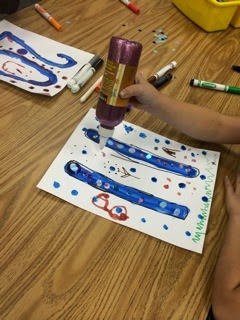
 First children choose a numeral to make their own. We get in a sequence line holding our number in front and then see who is one greater than our number and one fewer. Then, children paint their number inside the lines. This year I had 1 through 5 use one color, 5-10 use another, 10-15 use another, 15 - 20 use another, and 20+ use another. I thought it might help them see the groups of 5. Then, we let them dry. They can try to sequence them again.
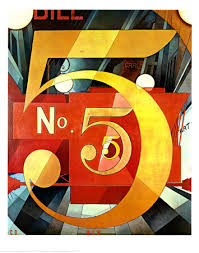
The next day we looked at an art print like this one, "No. 5". We simply ask children what they notice about the painting. They notice the numeral 5 with 3 different sizes, the letters, the colors, and the type of lines they see. Then, we offer their numeral to use as a piece of art similar to this one. This year I provided markers, glitter glue, and stickers for the art work. I asked them to try and follow around the numeral with a dark color to help the numeral show up well.


After they dry again, we had a "gallery stroll". I placed the numerals on their tables before they came in to class. Then, I played some instrumental music. When the music plays, the students walk around looking quietly at the art on the tables. When the music stops, they stop. I choose a student and ask a question. This time I just asked what they noticed. Then, we continue strolling and stopping to comment until we have enough.
Finally, we hung them up in order for all to see:)
.JPG)
Happy teaching!
Yours truly,
Molly
The next day we looked at an art print like this one, "No. 5". We simply ask children what they notice about the painting. They notice the numeral 5 with 3 different sizes, the letters, the colors, and the type of lines they see. Then, we offer their numeral to use as a piece of art similar to this one. This year I provided markers, glitter glue, and stickers for the art work. I asked them to try and follow around the numeral with a dark color to help the numeral show up well.
After they dry again, we had a "gallery stroll". I placed the numerals on their tables before they came in to class. Then, I played some instrumental music. When the music plays, the students walk around looking quietly at the art on the tables. When the music stops, they stop. I choose a student and ask a question. This time I just asked what they noticed. Then, we continue strolling and stopping to comment until we have enough.
Finally, we hung them up in order for all to see:)
Happy teaching!
Yours truly,
Molly
Tuesday, September 16, 2014

 Learning that letters are made of lines and curves, kindergarten students find SO MANY ways to write their names....out of colored tape, watercolor resist, letter magnets and even paper strips! They are also making name books to save. In these books they've traced their names with glitter glue, written it with rainbow colors, sticker dots, and q-tips dipped in paint. We've found these are a fun keepsake to send home at Back to School Night or at parent/teacher conferences.


Monday, September 8, 2014
Alphabet Museum
Our kindergarten classes have been in session for 10 days! Here are some pictures of the alphabet art & activities we are collecting for our Alphabet Museum Display. Look at these beautiful examples!
 |
| Apple Printing |
 |
| Bubble Wrap Prints & cut b's |
 |
| C collage (find C's from group of several letters) and a cut out camera |
 |
| dots on D's |
 |
| Handprint Elephants from eisforexplore.blogspot.com |
 |
| Flags painted on blue paper with red and white paint. Card stock folded in half and stapled to flag makes the pole. |
 |
| Glitter G's & g's |
 |
| E's with lines and curves |
 |
| h horse idea from missmarensmonkeys.blogspot.com I somehow didn't save any that had the h going the right way! Oh, the life of kindergarten! |
 |
| Insect i |
A big academic focus for kindergarten students is learning alphabet letters and the sounds they stand for. Our school district uses Harcourt Trophies curriculum for reading. We feel that the pacing for learning alphabet letters is too slow as it is paced throughout the year. We like to focus on the whole alphabet at the beginning of the year, then compact the Trophies curriculum for the balance of the year and focus on writing formation of the letters, and using the sounds for emerging reading. We also utilize the Zoo-Phonics letter sounds program. This program combines an animal character and a motion along with the sound associated with the letter. The animals are very motivating and the movements really help young learners learn and remember letter sounds. We also have the Waterford Early Learning Program on computer for children. We use the Nursery Rhyme songs and books as we introduce letters to make a connection to our hands on learning to their computer time.


Yours Truly, Molly
Subscribe to:
Posts (Atom)